
Energy prices remain unpredictable, grid capacity is tightening in parts of the UK, and more homeowners are asking the same question:
“How can I reduce my reliance on the grid?”
The answer isn’t just solar panels — it’s a properly designed, integrated home energy system. When solar, battery storage, EV charging and smart tariffs work together, you can dramatically reduce the amount of electricity you buy from the grid.
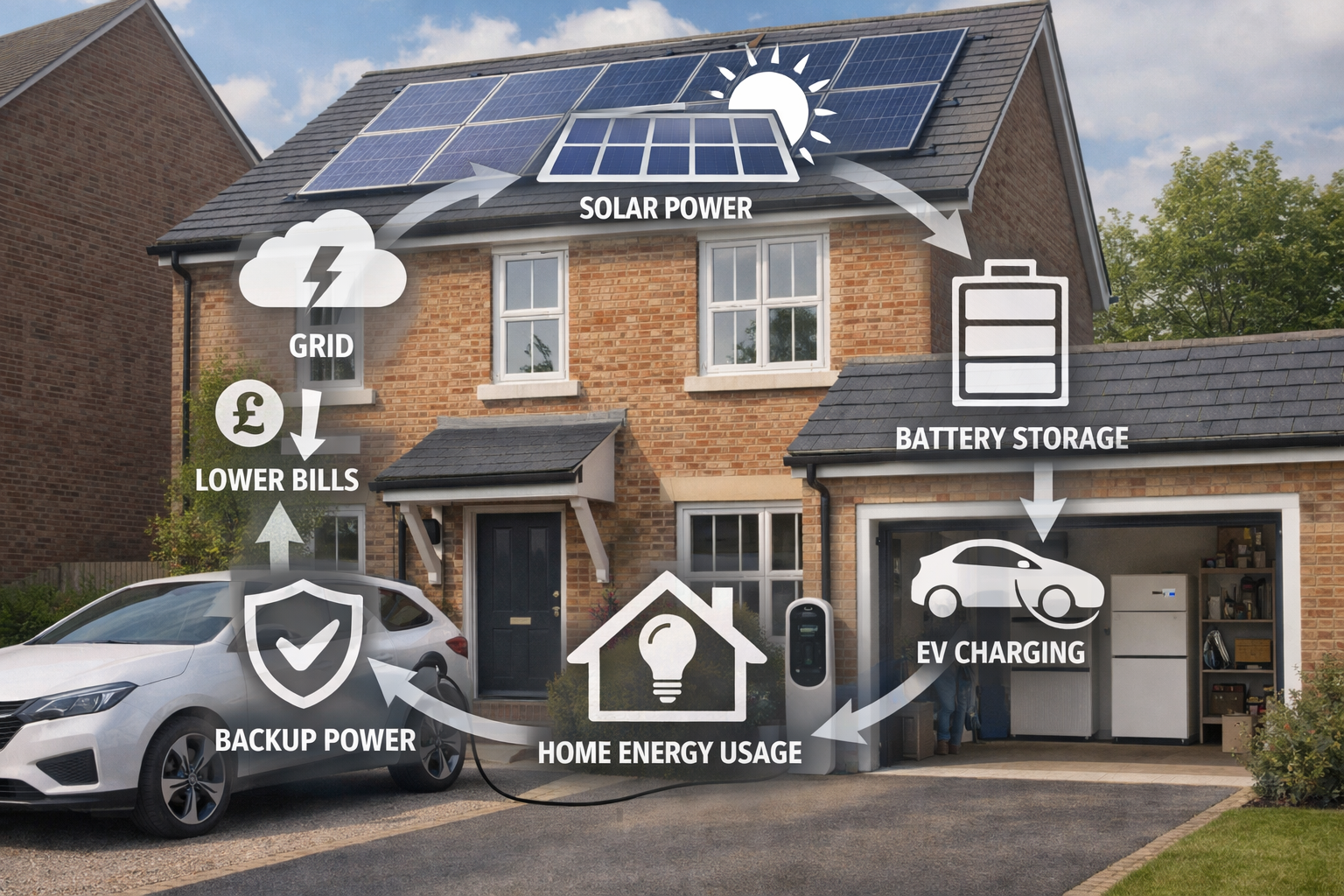
Here’s how to build a system that does exactly that.
Step 1: Start With Solar PV (Your Generation Layer)
Solar panels are the foundation of any low-grid home. Our solar panel installation services are designed to maximise generation and long-term savings.
A typical 4-6 kWp residential system in the South East can generate 3,500 to 5,000 kWh per year, covering a large proportion of daytime electricity usage.
To minimise grid reliance:
Maximise usable roof space where viable
Consider panel efficiency and orientation
Plan future expansion (EVs, heat pumps, extensions)
Solar reduces the electricity you need to buy - but on its own, it won’t eliminate grid use.
Why? Because most homes generate power in the day but use it in the evening.
That’s where storage comes in. Adding home battery storage allows you to store excess energy and reduce evening grid imports.
Step 2: Add Battery Storage (Your Control Layer)
A battery allows you to:
Store excess solar energy during the day
Use it in the evening instead of buying from the grid
Charge from cheap off-peak tariffs
Provide optional backup power
Without storage, many homes only use 30 to 40% of their solar energy directly.
With a battery, self-consumption can rise significantly - reducing both grid import and peak-rate exposure.
For most homes, a 5–15 kWh battery system is typical, depending on daily usage and savings goals.
Step 3: Optimise With Smart Tariffs
Even with solar and storage, you’ll likely still draw some grid electricity — especially in winter.
Smart time-of-use tariffs allow you to:
Charge your battery overnight at low rates
Discharge during peak-rate hours
Reduce average electricity cost
This is particularly effective for:
EV owners
Electrically heated homes
Higher energy households
When configured properly, your system automatically shifts energy use to the cheapest times.
Step 4: Integrate EV Charging
An EV is often the largest new electrical load in a home.
If unmanaged, it increases grid reliance.
If integrated correctly, it becomes part of your energy ecosystem.
A smart EV charger can:
Prioritise solar charging
Use stored battery energy
Charge during off-peak periods
Avoid peak tariff spikes
When combined with a smart EV charger, your system becomes a fully integrated energy solution.
Done properly, your EV becomes a controllable asset rather than a grid drain.
Step 5: Design for the Right Size (Avoid Underbuilding)
One of the biggest mistakes homeowners make is under-sizing systems.
To genuinely reduce grid reliance, your system should be designed around:
Annual kWh consumption
Evening and peak usage
Future loads (EV, heat pump, home office)
Desired backup capability
This is why professional system design and modelling matters - not just installing panels and hoping for the best.
Step 6: Understand Seasonal Reality
No UK home is 100% off-grid year-round without extreme oversizing.
In winter:
Solar generation drops
Heating demand rises
Grid use increases
The goal isn’t total independence.
The goal is:
Minimising peak-rate exposure
Reducing annual grid imports
Maximising self-generated energy use
Protecting against price volatility
What Does a Low-Grid Home Look Like?
A well-designed system in Surrey, Hampshire or Berkshire might include:
5–8 kWp solar array
10–15 kWh battery storage
Smart EV charger
Time-of-use tariff optimisation
This can dramatically reduce reliance on the grid and increase energy independence — especially in spring, summer and autumn.
Is It Worth It?
For many households in the South East:
Electricity savings improve ROI
Exposure to price spikes reduces
Backup capability adds resilience
Property appeal increases
The key is integration.
Solar alone reduces bills.
Battery alone shifts costs.
Tariffs alone reduce rates.
Combined, they form a complete energy strategy.
Final Thoughts
Minimising grid reliance isn’t about going fully off-grid.
It’s about:
Smarter design
Smarter storage
Smarter usage
When your system is built as one ecosystem rather than separate components, it becomes far more powerful.
If you’re considering building a home energy system tailored to your usage, our team at UK Green Energy Installations can assess your property and provide a detailed projection based on real consumption data.