

Take control of your home's energy from anywhere. Modern smart energy apps allow homeowners to monitor solar generation, battery storage, EV charging, and household energy usage in real time. Discover how integrated systems from leading manufacturers help maximise savings, improve efficiency, and give you complete visibility of your renewable energy system.
Why Choosing a Local Solar Company Matters
The blog explains that choosing a local solar company leads to better results because they understand regional property types and planning rules, allowing for more efficient system design. It highlights the importance of MCS-certified installation, strong attention to detail, and tailored system layouts to maximise energy generation. It also emphasises the value of ongoing local support, quicker maintenance, and long-term relationships built on reputation within the community.
Energy Bills Are Falling — But Solar & Battery Storage Still Makes Sense in 2026
The blog explains that while UK energy bills are falling slightly in 2026—with Ofgem reducing the price cap—this is only short-term relief and prices remain historically high.
It highlights that solar panels and battery storage still make strong financial sense because they provide long-term cost stability, reduced reliance on the grid, and protection against future price volatility. Rather than reacting to short-term price drops, investing in renewables allows homeowners and businesses to lock in savings, improve energy independence, and future-proof against ongoing market uncertainty.
Solar Battery Storage: AC-Coupled vs Hybrid Inverters – Which Is Right for You?
As solar power adoption grows across the UK, more households and businesses are exploring battery storage to maximise the benefits of their solar panels. But when adding storage, one of the most important decisions is how your batteries connect to the system — and that comes down to choosing between an AC-coupled inverter and a hybrid inverter.
Both options have their advantages, and the right choice will depend on whether you’re installing a new solar system or retrofitting to an existing one.
What Is a Hybrid Inverter?
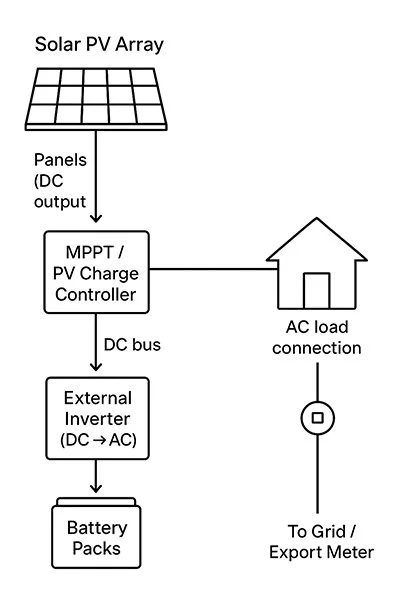
A solar inverter converts the direct current (DC) electricity generated by solar panels into alternating current (AC), which powers your home. Some batteries include built-in inverters, while others rely on external inverters.
A hybrid inverter is a single device that manages both your solar panels and battery storage.
It takes DC electricity directly from your solar panels.
It can send that DC into your batteries for storage.
It also converts DC → AC for household use and export to the grid.
In short: one piece of equipment does it all.
✅ Simplifies installation
✅ Space-saving design
✅ Higher efficiency (less energy lost in conversions)
❌ More expensive upfront if you already own a standard solar inverter
❌ If the hybrid inverter fails, both solar and battery stop working
What Is an AC-Coupled Inverter?
An AC-coupled inverter is a separate battery inverter that works alongside your existing solar inverter.
The solar inverter converts solar DC → AC for your home.
The AC-coupled inverter then takes that AC, re-converts it into DC to charge the battery, and back into AC when discharging.
In short: it’s an add-on that lets you keep your existing setup.
✅ Ideal for retrofits (you don’t need to replace your solar inverter)
✅ Flexible — easy to upgrade or replace components separately
✅ Can sometimes keep solar and battery running independently if one fails
❌ Slightly less efficient (extra conversion steps)
❌ Requires more wiring and space
Which Is Right for You?
Installing a brand-new solar system?
A hybrid inverter is usually the most efficient and tidy solution, giving you seamless integration and fewer energy losses.Already have solar panels?
An AC-coupled inverter is often the smarter choice, letting you add batteries without scrapping your existing equipment.
At the end of the day, both options can deliver reliable savings and greater energy independence. The best choice depends on your setup, your budget, and how future-proof you want your system to be.
| Feature | Hybrid Inverter | AC-Coupled Inverter |
|---|---|---|
| Best For | Brand-new solar + battery installs where simplicity and efficiency are priorities. | Retrofitting battery storage to an existing solar system without replacing the solar inverter. |
| Efficiency | Higher — direct DC coupling reduces conversion losses (fewer DC↔AC stages). | Lower — involves extra conversions (solar DC→AC then battery AC→DC→AC), which can slightly reduce round-trip efficiency. |
| Installation | One combined unit, simpler wiring and a more compact footprint; quicker install overall. | Requires separate solar and battery inverters, more wiring and space — typically a longer install. |
| Upfront Cost | Often better value when starting fresh (one device handles everything), though hybrid units can be pricier per unit. | Can be cheaper for retrofits because you keep your existing solar inverter; battery inverter is an add-on. |
| Flexibility / Scalability | More limited — you’re constrained by the hybrid unit’s specs and upgrade path. | Highly flexible — easier to scale storage, change brands, or replace a single component later. |
| Resilience / Redundancy | Single point of failure: if the hybrid inverter fails, both PV generation and battery may be offline. | Greater independence: solar and battery systems can sometimes operate separately if one inverter fails. |
| Typical Use Case (short) | New install — households wanting a tidy, efficient integrated system. | Retrofit — owners who already have solar and want to add storage without major replacement. |
Note: hybrid inverters are typically the most efficient for new installs; AC-coupled setups offer flexibility for retrofits.
Ready to Explore Your Options?
At UK Green Energy Installations, we design and install tailored solar and battery solutions across the South of England. Whether you’re starting fresh or upgrading an existing system, we’ll help you choose the right inverter technology to maximise your investment.
📞 Contact us today to discuss your solar battery storage options on 0333 577 5229