
Vehicle-to-Home (V2H) technology is becoming one of the most talked-about features in the energy and EV space — but there’s still a lot of confusion around which vehicles actually support it.
Important: The information on this page is correct at the time of the latest update, but V2H capability is evolving rapidly and may change as manufacturers release software updates, new charging solutions or new vehicle models..
V2H UK Update – September 2026
This guide was originally published in April 2026 and has been updated in September 2026 to reflect the latest developments in Vehicle-to-Home (V2H) and bidirectional EV charging in the UK.
V2H is moving closer to wider UK adoption, with developments in compatible vehicles, bidirectional charging, grid connections and V2X services. However, availability still depends on the specific combination of EV, charger, software, home energy system and network requirements.
What is Vehicle-to-Home (V2H)?
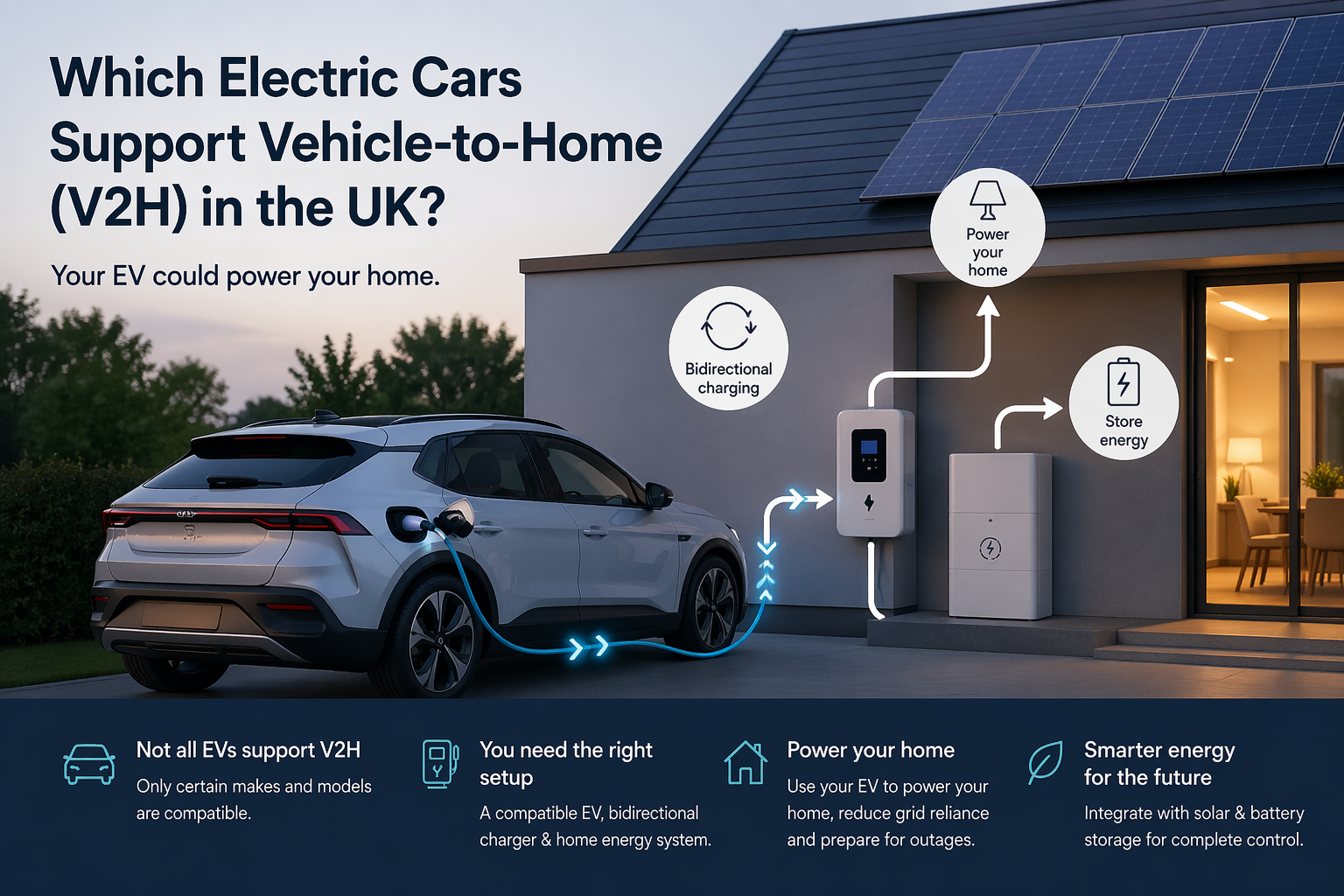
Vehicle-to-Home (V2H) allows your electric vehicle to supply power back to your home, effectively turning your car into a mobile battery.
This can be used to:
Power your home during outages
Reduce reliance on the grid
Optimise energy usage alongside solar and battery systems
Which electric cars currently support V2H in the UK?
The number of electric cars capable of bidirectional charging is growing, but a vehicle being technically capable of V2H does not necessarily mean V2H can currently be used in a UK home. Compatibility can depend on the vehicle model and software, charging protocol, bidirectional charger, home energy system and electricity network requirements.
The table below summarises the current position for some of the EVs and manufacturers most commonly associated with V2H and bidirectional charging in the UK.
| Vehicle / Manufacturer | Bidirectional Capability | UK V2H Position | What to Know |
|---|---|---|---|
| BYD | Selected models support bidirectional functionality | Limited availability | BYD is involved in UK bidirectional charging initiatives, including the Octopus Power Pack V2G service with compatible vehicles and charging equipment. Compatibility must be checked for the individual model and system. |
| Nissan LEAF | Yes – CHAdeMO supports bidirectional charging | Possible with compatible equipment | The LEAF has long been used in UK V2G and V2H trials. It requires compatible CHAdeMO bidirectional charging equipment, which limits mainstream domestic use. |
| Hyundai | V2L available on selected models; wider V2X capability developing | V2H developing | Models such as the IONIQ 5 offer Vehicle-to-Load (V2L), but V2L should not be confused with whole-home V2H. Hyundai Motor Group is developing wider V2X services, including V2H and V2G. |
| Kia | V2L available on selected models; wider V2X capability developing | V2H developing | Vehicles including the EV6 and EV9 provide V2L functionality. Wider bidirectional home and grid integration depends on compatible vehicle, charger and service support. |
| Renault 5 E-Tech | Bidirectional charging capability | Ecosystem dependent | Renault has developed bidirectional charging through its Mobilize ecosystem. UK functionality depends on compatible charging hardware, services and vehicle specification. |
| Volkswagen ID. models | Selected vehicles have bidirectional capability | Limited UK availability | Bidirectional capability has been introduced for selected ID. vehicles and battery configurations, but UK domestic V2H availability remains dependent on compatible hardware and services. |
| Tesla | Model and market dependent | Not generally available as UK V2H | Tesla has introduced bidirectional functionality in parts of its ecosystem, but conventional V2H from Tesla passenger vehicles is not currently a generally available UK home-energy solution. |
Important: Vehicle-to-Home compatibility is changing rapidly. A vehicle having V2L or bidirectional charging capability does not automatically mean it can power a UK home. Always check the specific vehicle, charger, software and home energy system before specifying V2H.
V2L isn't the same as V2H
Some electric cars offer Vehicle-to-Load (V2L), allowing the vehicle battery to supply electricity directly to appliances or other electrical equipment.
V2H goes a step further. It integrates the EV battery with the home's electrical system through compatible bidirectional charging equipment, allowing energy stored in the vehicle to supply the property.
So, while a car may offer V2L, that doesn't necessarily mean it supports V2H.
Can Sigenergy use an EV battery for V2H?
Sigenergy is particularly relevant to Vehicle-to-Home because the SigenStor ecosystem has been designed to integrate solar PV, battery storage and EV charging within one energy management system.
The Sigen EV DC Charging Module is designed for bidirectional charging, meaning that with a compatible electric vehicle and system configuration, energy can potentially flow both into and out of the EV battery.
This creates the possibility of using a compatible EV as an additional source of stored energy alongside a SigenStor home battery.
However, having a bidirectional charger does not automatically mean V2H will work with every electric vehicle in the UK. Compatibility depends on the individual vehicle, its charging protocol and manufacturer software, as well as the charging equipment, SigenStor configuration and applicable UK grid requirements.
For homeowners considering solar, battery storage and an EV charger together, this is worth considering when designing a system — particularly if V2H is something you may want to use in the future.
UK Green Energy Installations is a Sigenergy specialist serving Surrey, Hampshire and Berkshire. We can help design a SigenStor system around your current energy requirements while considering future EV charging and V2H requirements.
🔮 Planning for the Future? Build a V2H-Ready System Today
You don't need to wait for vehicle manufacturers to catch up before installing solar. The smartest move today is installing an infrastructure that won't become obsolete. By choosing a SigenStor ecosystem now, you get an industry-leading home battery today, with a native, built-in gateway to activate Vehicle-to-Home charging the exact moment your EV manufacturer pushes the software update.
Why Doesn’t Every EV Support V2H?
There are a few reasons:
Hardware limitations – not all vehicles are built for bidirectional power
Software restrictions – manufacturers control how energy flows
Grid regulations – exporting power to your home/grid requires compliance
Ecosystem control – some brands (like Tesla) prefer closed systems
What Do You Actually Need for V2H?
Even if your car supports it, you still need:
A bidirectional charger
A compatible inverter or energy system
A properly configured home electrical setup
Notification to or approval from your Distribution Network Operator (DNO), where required
This is why V2H is not yet “plug and play” for most UK homes.
Is V2H Worth It in the UK?
V2H is moving closer to practical use in the UK, but compatibility remains the biggest consideration. The vehicle, bidirectional charger, home energy system, software and grid connection all need to work together.
For most homeowners today, a dedicated home battery remains the most reliable and immediate way to slash energy bills, while providing the ultimate foundation for future V2H integration. If you want to see how a smart, stackable battery system fits into your home budget, view our Fully Installed Sigenergy Battery Price Guide (2026) or speak directly with our engineering team in Surrey, Hampshire, and Berkshire for a custom setup.
As more manufacturers enable bidirectional charging and compatible UK charging solutions become available, an EV could increasingly form part of the home's wider energy storage system rather than simply being an electrical load.
Not sure about the terminology?
See our solar, battery and EV glossary for explanations of V2H, V2G, V2L and other common terms.
Frequently Asked Questions
Can any electric car power a house?
No — only electric vehicles with true Vehicle-to-Home (V2H) capability can do this. Many EVs only support Vehicle-to-Load (V2L), which allows you to power appliances but not your home.
Why doesn’t my EV support V2H?
Most electric vehicles are not designed for bidirectional energy flow, or manufacturers have not enabled the feature. V2H also requires specific hardware and approvals to work safely.
Is Tesla compatible with V2H in the UK?
Not in a standard setup. While Tesla has introduced limited functionality in some markets, it is not widely available or supported for typical UK home installations.
Do I need solar panels for V2H?
No — V2H can work without solar. However, combining it with solar and battery storage can provide greater flexibility and long-term energy savings.
What is the difference between V2H, V2G and V2L?
V2H (Vehicle-to-Home) allows a compatible EV battery to supply electricity to a home. V2G (Vehicle-to-Grid) allows stored energy to be exported from the EV to the electricity grid. V2L (Vehicle-to-Load) allows an EV to power individual appliances or electrical equipment. All three use energy stored in the vehicle battery, but they are not the same functionality.