
From Enquiry to Export Payments: How the Solar Installation Process Works in the UK
If you're thinking about installing solar panels, you've probably wondered what actually happens after you request a quote.
Questions such as "How does the Smart Export Guarantee work?", "How do I get paid for exporting solar electricity?" and "What happens after a solar installation?" are some of the most common questions homeowners ask.
The good news is that the process is straightforward when you work with an experienced MCS-certified installer.
Below we've explained each stage of the journey, from your first enquiry through to receiving payments for exporting surplus electricity back to the grid.
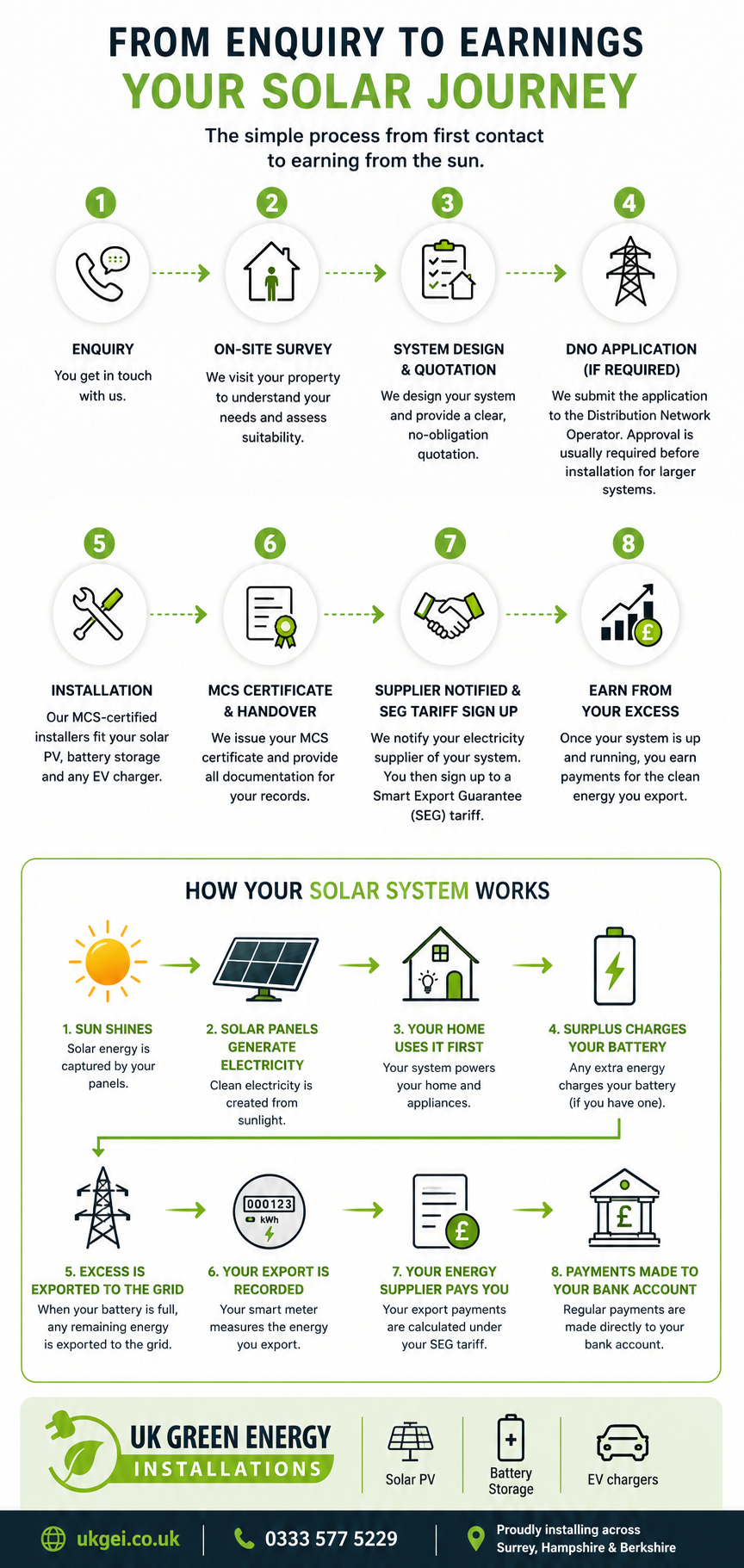
Step 1 – Initial Enquiry
Everything starts with a conversation.
We'll discuss:
Your current electricity usage
Your property
Your roof orientation
Whether battery storage would benefit you
Whether you're considering an EV charger
This initial discussion helps determine whether solar PV is likely to provide a worthwhile return on investment.
Step 2 – On-Site Survey
One of our engineers visits your property to carry out a detailed survey.
During this visit we assess:
Roof size and condition
Shading from trees or neighbouring buildings
Consumer unit location
Cable routes
Space for battery storage
Existing electrical installation
This information allows us to design a system specifically for your home.
Step 3 – System Design & Quotation
Using specialist solar design software, we create a bespoke system designed around your property and electricity usage.
Your quotation will typically include:
Estimated annual generation
Predicted self-consumption
Battery performance (if included)
Estimated export
Financial savings
Payback estimates
Equipment specifications
Every property is different, so systems are designed individually rather than using a "one size fits all" approach.
Step 4 – DNO Application (Where Required)
Some installations require approval from your local Distribution Network Operator (DNO).
The DNO manages the local electricity network rather than supplying your electricity.
Depending on the size and type of system being installed, permission may need to be obtained before installation.
Don't worry—we handle the application process on your behalf.
Step 5 – Installation
Once everything has been approved, installation can begin.
Most domestic installations are completed within one to three days depending on the size and complexity of the project.
Installation may include:
Solar PV panels
Inverter
Battery storage
EV charger
Monitoring system
All work is completed by qualified installers in accordance with current regulations.
Step 6 – MCS Certification & Handover
After installation, you'll receive your MCS certification and all relevant documentation.
This certification is important because it demonstrates that your installation complies with recognised industry standards and is typically required when applying for a Smart Export Guarantee (SEG) tariff.
We'll also show you how to monitor your system and answer any questions before handover.
Who Does What During Your Solar Installation?
One of the most common questions homeowners ask is who is responsible for each stage of the solar installation process. There are several organisations involved, each with a different role. Understanding who does what can help make the process much clearer.
| Organisation | What They Do |
|---|---|
| UK Green Energy Installations | Designs your solar PV system, carries out the installation, commissions the equipment, provides handover documentation and guides you through the installation process. |
| Distribution Network Operator (DNO) | Manages the local electricity network and approves or records grid connections where required. Your DNO is not your electricity supplier. |
| MCS Certification Scheme | Provides the certification framework that demonstrates eligible renewable energy installations have been completed by certified installers in accordance with recognised standards. |
| Your Electricity Supplier | Supplies electricity to your home and, if you register for a Smart Export Guarantee (SEG) tariff, pays you for eligible electricity exported to the grid. |
| You | Choose your preferred equipment, approve the quotation, decide which Smart Export Guarantee tariff best suits your needs and enjoy generating your own renewable electricity. |
Although several organisations are involved, your installer should coordinate the process and provide guidance from your initial enquiry through to system handover. Once your installation is complete and your Smart Export Guarantee tariff is active, your system can begin generating renewable electricity, powering your home and exporting surplus energy back to the grid.
Step 7 – Register for a Smart Export Guarantee (SEG) Tariff
Now comes the part many homeowners look forward to.
You'll need to apply for a Smart Export Guarantee (SEG) tariff with an electricity supplier that offers export payments.
Not all suppliers offer the same rates, so it's worth comparing available tariffs.
Your installer cannot choose your tariff for you, but we can explain how the process works.
Step 8 – Start Generating, Using and Exporting Electricity
Once your system is operational, the process becomes automatic.
The sun shines.
Your solar panels generate electricity.
Your home uses this electricity first.
Any surplus charges your battery (if installed).
Once your battery is full, excess electricity is exported to the grid.
Your smart meter records how much electricity has been exported.
Your electricity supplier calculates your export payments.
Payments are made according to your chosen Smart Export Guarantee tariff.
It's a simple system that works in the background every day.
Frequently Asked Questions About the Solar Installation Process
How does the solar installation process work in the UK?
The solar installation process usually begins with an initial enquiry, followed by an on-site survey, system design and quotation. Where required, a DNO application is completed before installation. After the system is installed, the customer receives their handover documents and MCS certificate, then applies for a Smart Export Guarantee tariff with an eligible energy supplier.
How long does it take to install solar panels?
Most domestic solar panel installations are completed within one to three days. The overall process may take several weeks from enquiry to installation, depending on survey availability, equipment lead times, scaffolding, DNO approval and the complexity of the system.
What happens during a solar panel survey?
During a solar panel survey, the installer assesses the roof, shading, orientation, available installation space, electrical supply, consumer unit, cable routes and potential locations for the inverter and battery. The survey information is then used to produce a suitable system design and quotation.
What is DNO approval for solar panels?
DNO approval relates to the connection of a solar or battery system to the local electricity network. Some smaller systems can be notified after installation, while larger systems or certain inverter configurations may require approval before installation begins. Your installer should identify the correct process and handle the application where required.
Does every solar installation need DNO approval?
Every grid-connected solar installation must be notified to the relevant Distribution Network Operator, but not every system requires advance approval. Whether approval is needed before installation depends on the system size, inverter capacity, battery configuration and the requirements of the local network.
What is an MCS certificate and why do I need one?
An MCS certificate confirms that an eligible renewable energy installation has been completed by an MCS-certified installer in accordance with the relevant scheme requirements. It is commonly requested when applying for a Smart Export Guarantee tariff and should be retained with the rest of the system handover documents.
How do I get paid for exporting solar electricity?
To receive payment for exported solar electricity, you normally need an eligible solar installation, a suitable export meter and an account with an energy supplier offering a Smart Export Guarantee tariff. The supplier records or receives your export readings and pays you according to the tariff terms you have agreed.
What is the Smart Export Guarantee?
The Smart Export Guarantee, often shortened to SEG, is a scheme through which participating electricity suppliers pay eligible small-scale generators for renewable electricity exported to the grid. Export rates, payment schedules and eligibility requirements vary between suppliers.
Do I need a battery to receive solar export payments?
No, you do not need a battery to receive solar export payments. A battery stores surplus electricity for use later in the home, which can reduce the amount of electricity bought from the grid. Once the battery is full, any further surplus can usually be exported where the system is configured to do so.
Does solar electricity power the home before it is exported?
Yes. In a typical home solar system, the electricity generated is used by the property first. Any remaining surplus may then charge a battery, if one is installed, before excess electricity is exported to the grid.
How much can I earn from exporting solar electricity?
The amount you can earn depends on how much surplus electricity your system exports and the export tariff agreed with your energy supplier. Solar generation, household consumption, battery use, system size, roof orientation and seasonal weather conditions can all affect export volumes.
Can I choose any energy supplier for a Smart Export Guarantee tariff?
You can apply to an energy supplier that offers an export tariff and accepts your installation, although eligibility rules vary. Your export supplier does not always have to be the same company that supplies your imported electricity, but you should check the terms of each available tariff carefully.
What documents will I receive after my solar installation?
Your handover pack may include the MCS certificate, electrical certification, equipment warranties, system design information, commissioning records, user manuals, DNO documentation and instructions for monitoring the system. The exact documents will depend on the equipment and installation.
Can solar panels, battery storage and an EV charger be installed together?
Yes. Solar panels, battery storage and an EV charger can be designed as part of an integrated home energy system. A suitable design can help the property use more of its own solar generation, store surplus electricity and charge an electric vehicle when energy is available.