
For businesses considering commercial solar panels, the cost of purchasing and installing a system is often one of the first considerations.
Buying a commercial solar PV system outright is one option, but businesses may also come across Power Purchase Agreements (PPAs) when researching ways to install solar without making a large upfront capital investment.
So, what is a solar PPA, how does it work, and how does it compare with buying a commercial solar system outright?
What Is a Solar Power Purchase Agreement?
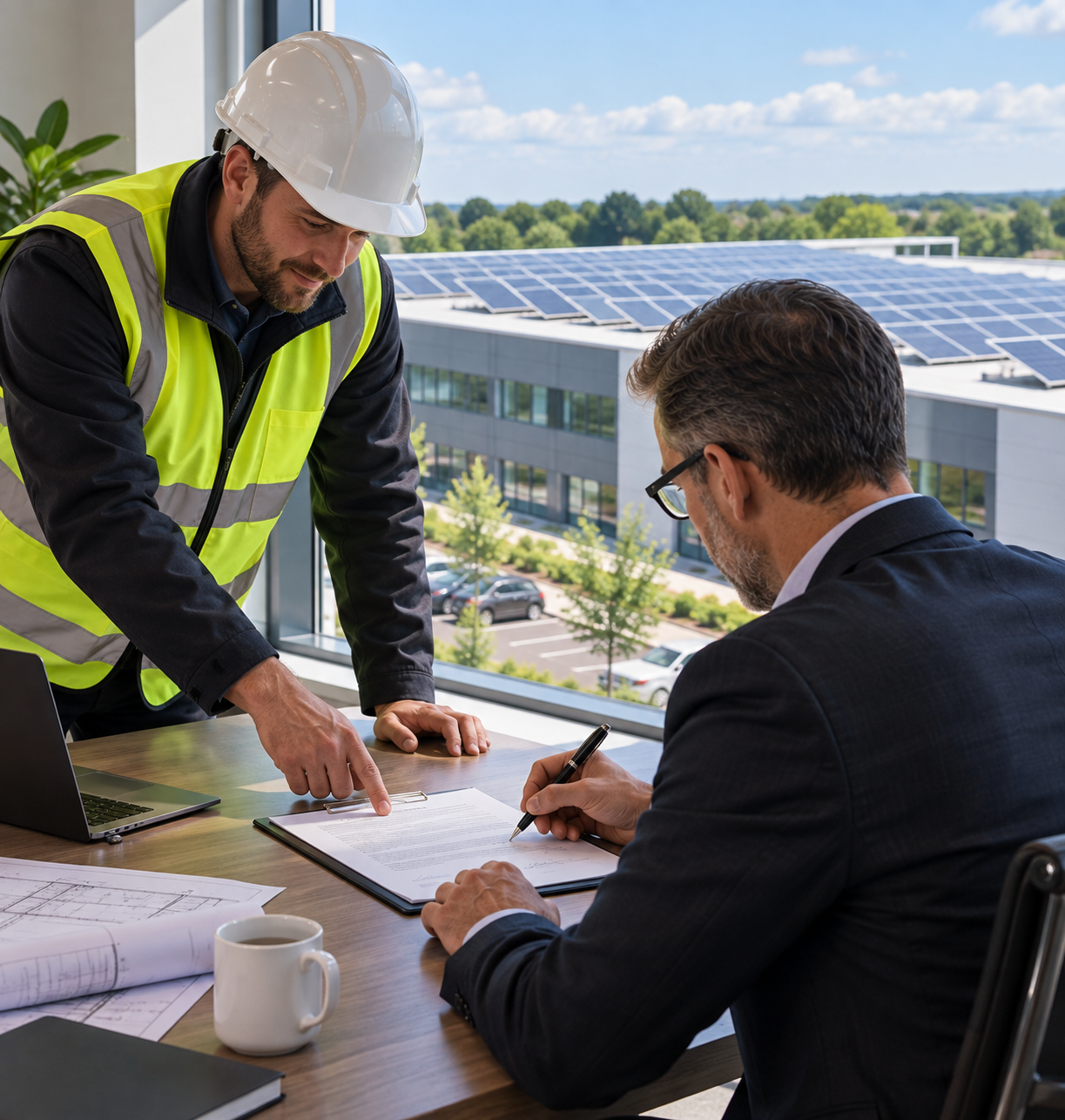
A Power Purchase Agreement (PPA) is a long-term agreement under which a business purchases electricity generated by a renewable energy system at an agreed price.
For an on-site solar PPA, a third-party provider typically finances and owns a solar PV system installed on the business's roof, land or other suitable space.
Rather than purchasing the solar panels themselves, the business agrees to buy electricity generated by the system for an agreed period and at an agreed rate.
This can allow a business to benefit from on-site solar generation without paying the full cost of the solar installation upfront.
Does UKGEI Offer Solar Power Purchase Agreements?
UK Green Energy Installations does not currently offer Power Purchase Agreements (PPAs). We design and install commercial solar PV systems for businesses purchasing their systems directly. This guide is intended to explain how solar PPAs work and help businesses compare a PPA with purchasing and owning a commercial solar installation outright.
How Does a Commercial Solar PPA Work?
Although individual agreements vary, an on-site solar PPA will generally work something like this:
1. The site is assessed
The provider assesses factors such as available roof or land space, electricity consumption, daytime energy demand and the suitability of the site for solar PV.
2. A third party finances the installation
Instead of the business purchasing the solar installation, the PPA provider or funding partner finances the project.
3. Solar panels are installed at the business premises
The system generates electricity which can be used directly by the building.
4. The business purchases the solar electricity
Rather than owning the equipment, the business pays an agreed price for electricity generated under the terms of the PPA.
The business will normally retain its conventional electricity supply for periods when solar generation does not meet its electricity requirements.
5. The agreement continues for an agreed term
PPAs are generally long-term commercial arrangements. The exact contract length, electricity pricing, maintenance responsibilities and what happens to the equipment at the end of the agreement depend on the individual contract.
Solar PPA vs Buying Commercial Solar Outright
One of the biggest decisions for a business considering solar is whether to own the system or purchase the electricity it generates through a PPA.
| Buying Solar Outright | Solar PPA | |
|---|---|---|
| Upfront investment | Business funds the installation | Typically little or no upfront capital required |
| Who owns the solar system? | The business or property owner | Usually the PPA provider or funder during the agreement |
| Solar electricity | Generated electricity is available to the system owner | The business purchases the electricity generated under the PPA |
| Potential long-term savings | Greater potential to benefit directly once the installation cost has been recovered | Depends on the agreed electricity price and contract terms |
| Maintenance | Owner is responsible, subject to warranties and maintenance arrangements | Often handled by the provider, depending on the agreement |
| Contract commitment | No long-term electricity-purchase agreement | Normally involves a long-term contract |
| Asset ownership | The business owns the solar PV asset | Usually owned by the provider during the PPA term |
| Best suited to | Businesses able to invest capital and wanting ownership | Businesses wanting solar without significant upfront capital |
Neither approach is automatically better. The right choice depends on the organisation's finances, property arrangements, electricity consumption and long-term plans.
What Are the Advantages of a Solar PPA?
The most obvious advantage is reducing or removing the upfront capital requirement.
This may allow an organisation to install solar while retaining capital for other priorities such as machinery, premises, staffing or business expansion.
A PPA can also provide greater visibility over the cost of the electricity generated by the system, depending on how the agreement's pricing is structured.
Operation and maintenance may also be the responsibility of the PPA provider, although businesses should always check exactly what is included in an individual agreement.
What Are the Potential Disadvantages?
The main consideration is the long-term commitment.
While buying a solar system requires greater initial investment, the business owns the asset. With a PPA, the business is entering into a contract to purchase electricity over an extended period.
Before entering into a PPA, businesses should understand issues such as:
how the electricity price is calculated and whether it increases over time;
the length of the agreement;
who is responsible for maintenance, repairs and insurance;
what happens if the property is sold or the business moves;
arrangements for leased buildings;
early termination provisions; and
what happens to the solar equipment at the end of the contract.
Independent legal and financial advice may therefore be appropriate before entering into a long-term PPA.
What Is the Difference Between a Solar PPA and a Solar Lease?
The terms are sometimes confused, but there is an important distinction.
With a solar PPA, the customer generally pays for the electricity generated by the solar system.
With a solar lease, the customer generally pays an agreed amount for the use of the solar equipment.
The precise structure varies between providers, so businesses should compare the complete commercial terms rather than simply comparing headline monthly costs.
Who Might Consider a Commercial Solar PPA?
On-site PPAs can be particularly relevant to organisations with substantial daytime electricity consumption and suitable roof or land space.
This might include:
manufacturing and industrial businesses;
warehouses and distribution centres;
offices and larger business premises;
schools and colleges; and
other organisations looking to reduce reliance on grid electricity without allocating substantial capital to a solar installation.
In fact, in 2026 the Department for Education announced a pilot using PPAs to finance solar PV installations on some schools and colleges in England.
Does UKGEI Offer Solar Power Purchase Agreements?
UK Green Energy Installations does not currently provide Power Purchase Agreements.
We believe, however, that businesses researching commercial solar should understand the different options available to them.
UKGEI designs and installs commercial solar PV systems for businesses purchasing their solar installation directly. Owning the system means the solar installation becomes an asset of the business or property owner, without an ongoing PPA agreement for the electricity it generates.
For businesses able to make the initial investment, outright ownership can provide a straightforward route to reducing the amount of electricity purchased from the grid and benefiting from the system's generation over the longer term.
PPA or Outright Purchase: Which Is Right for Your Business?
There isn't one answer for every organisation.
A PPA may be attractive where avoiding upfront capital expenditure is the priority. Outright purchase may be preferable for businesses that have the available capital, want to own the renewable energy asset and want to maximise the long-term benefit of the electricity it generates.
Whichever route you're considering, the starting point should be understanding how much electricity your premises uses, when it uses it and how much of that demand could realistically be supplied by solar PV.
UK Green Energy Installations designs commercial solar installations across Hampshire, Surrey and Berkshire, helping businesses assess their energy consumption, available space and the potential benefits of investing in their own commercial solar PV system.
Frequently Asked Questions
What is a solar Power Purchase Agreement (PPA)?
A solar Power Purchase Agreement (PPA) is an arrangement where a third-party provider typically finances and owns a solar PV system installed at a business premises. The business then purchases the electricity generated by the solar panels at an agreed rate for an agreed period, rather than purchasing the solar installation outright.
Is a solar PPA cheaper than buying solar panels outright?
Not necessarily. A PPA can reduce or remove the need for significant upfront capital, but the business continues to purchase the electricity generated under the terms of the agreement. Buying commercial solar panels outright requires greater initial investment, but the business owns the system and can benefit directly from the electricity it generates. The most suitable option depends on the organisation's finances, energy consumption and long-term plans.
Who owns the solar panels under a PPA?
Under an on-site solar PPA, the solar PV system is usually owned by the PPA provider or funding partner during the agreement. The business uses the electricity generated by the system and pays for it according to the terms of the PPA. Ownership arrangements at the end of the agreement vary, so the contract should be checked carefully.
What happens at the end of a solar PPA?
What happens at the end of a solar PPA depends on the individual agreement. Options may include extending the agreement, purchasing the solar PV system or having the equipment removed. Businesses should understand the end-of-contract arrangements before entering into a PPA, including any costs or conditions that may apply.