
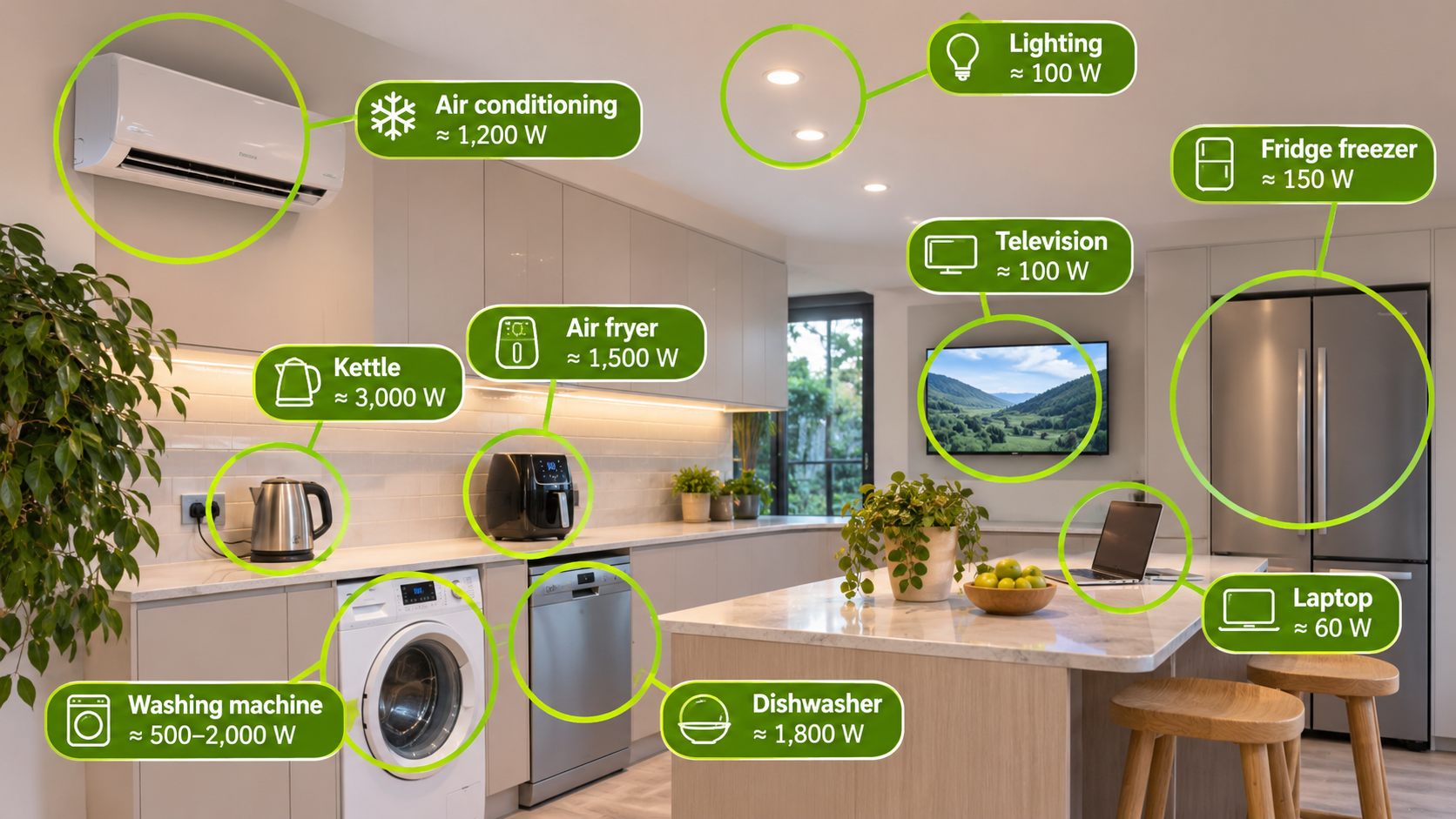
When considering solar panels, homeowners often ask a simple question: what can they actually power? While solar systems are usually described in kilowatts (kW) or kilowatt-peak (kWp), these figures don't immediately explain how much electricity is available for everyday appliances.
In this guide, we use eight 450 W Trina solar panels as an example to explore what a typical residential solar installation could power, from air conditioning and washing machines to kettles and electric vehicles.
We'll also explain why solar generation changes throughout the day, how appliances can share the electricity being generated, and how battery storage can help homeowners use more of their solar energy.
How Much Electricity Do 8 Solar Panels Generate?
Eight solar panels rated at 450 W each provide a combined installed capacity of 3,600 W, or 3.6 kWp.
The 3.6 kWp figure represents the panels' combined rated DC output under standard test conditions. Actual electricity generation depends on sunlight, panel temperature, roof orientation, shading, system losses and inverter capacity.
What Household Appliances Could 8 Solar Panels Power?
Different household appliances require very different amounts of electricity. Some use relatively little power continuously, while others draw considerably more electricity for short periods.
| Household appliance | Example power demand | Typical consideration |
|---|---|---|
| Fridge freezer | 150 W | Compressor cycles on and off |
| Television | 100 W | Generally low consumption |
| Laptop | 60 W | Varies with charging and use |
| Air conditioning | 1,200 W | Depends on system size and cooling demand |
| Washing machine | 500–2,000 W | Higher when heating water |
| Dishwasher | 1,800 W | Higher during water heating |
| Air fryer | 1,500 W | Heating element cycles during cooking |
| Kettle | 3,000 W | High demand for a short period |
| EV charger | 1,400–7,400 W | Depends on charging settings and vehicle |
These are illustrative appliance ratings, not measurements from specific products. Actual power consumption should be checked against the manufacturer's specifications. Appliance demand can change considerably during operation.
Example 1: A Sunny Summer Afternoon
Could Solar Panels Run Air Conditioning?
Yes. A suitably sized solar installation could potentially generate enough electricity to run a domestic air-conditioning unit during sunny daylight hours.
For example, imagine a homeowner using a 1,200 W air-conditioning system while other household appliances are operating.
| Appliance | Power demand |
|---|---|
| Air conditioning | 1,200 W |
| Washing machine (illustrative phase) | 500 W |
| Fridge freezer | 150 W |
| Television | 100 W |
| Laptop | 60 W |
Assumed solar output: 3,400 W
Potential surplus: 1,390 W
Under these particular conditions, the solar installation could meet the example household demand without importing electricity from the grid at that moment.
However, if the washing machine begins heating water, the air-conditioning compressor increases its output, or clouds reduce solar generation, additional electricity may be imported.
Example 2: Cooking and Running Appliances
What Happens When Several Appliances Run Together?
Consider a homeowner preparing lunch while other appliances are running.
| Appliance | Power demand |
|---|---|
| Air fryer | 1,500 W |
| Dishwasher (heating phase) | 1,800 W |
| Fridge freezer | 150 W |
| Television | 100 W |
Assumed solar output: 3,400 W
Potential grid import: 150 W
Even though the combined demand is greater than the solar generation available, the panels could still provide most of the electricity required at that moment.
In a normal grid-connected installation, the electricity supply automatically makes up the difference. The homeowner does not need to switch appliances off simply because solar generation is lower than household demand.
Example 3: What About a Cloudy Winter Day?
Solar Generation During Lower-Light Conditions
Solar panels continue generating electricity in winter, but their output is generally lower because daylight hours are shorter and sunlight is less intense.
For illustration, imagine the same eight-panel system is generating just 700 W of usable electricity at a particular moment.
| Appliance | Power demand |
|---|---|
| Fridge freezer | 150 W |
| Television | 100 W |
| Laptop | 60 W |
| Household lighting | 100 W |
Assumed solar output: 700 W
Potential surplus: 290 W
Even at this lower output, the solar panels could meet the illustrated demand from these smaller appliances.
The 700 W figure is an example only. Actual winter generation can be substantially higher or lower, including very little output during particularly poor conditions.
Try Our Solar Appliance Calculator
Use the calculator below to explore how different appliances might share the electricity generated by eight 450 W solar panels.
What Could Your Solar Panels Power?
Adjust the illustrative solar generation level, then select the appliances you would like to run simultaneously.
100% represents the assumed 3,400 W usable AC output in this example, not a forecast of actual sunlight or generation.
This calculator compares instantaneous power in watts, not energy consumption in kWh. It does not calculate annual savings, battery runtime or backup-power capability. It assumes a normal grid-connected installation with suitable inverter capacity and no battery charging or discharging.
What Happens If Solar Panels Generate More Electricity Than You Need?
When solar generation exceeds household demand, the surplus electricity may be exported to the electricity grid or used to charge a compatible home battery storage system.
For example, if your solar panels are generating 3,000 W while your home is using 1,000 W, approximately 2,000 W may be available for export or battery charging, subject to system losses, settings and any export restrictions.
This is one reason why battery storage can be valuable. Rather than exporting all unused solar electricity during the day, homeowners may be able to store some of it for use later.
Could You Run an Electric Vehicle Charger From Solar?
Yes, although the amount of solar electricity available will influence how quickly the vehicle can charge.
A conventional single-phase home EV charger may draw up to approximately 7.4 kW, considerably more than the rated output of an eight-panel 3.6 kWp solar array.
However, compatible smart chargers can adjust charging rates to make use of surplus solar generation. Some support charging at reduced rates, subject to vehicle compatibility, minimum charging requirements and charger settings.
For homeowners interested in solar-powered EV charging, UK Green Energy Installations can assess solar generation, household demand and suitable charging equipment.
Would Adding Battery Storage Make a Difference?
Solar panels generate electricity during daylight hours, while household demand often continues into the evening.
A home battery can store some surplus solar electricity for later use, potentially reducing the amount purchased from the grid.
Some systems can also charge from the grid during lower-cost electricity tariff periods. This may be particularly useful in winter when solar generation is reduced.
Does Having More Solar Panels Mean You Can Run More Appliances?
Increasing the number of solar panels increases the installed generation capacity, provided the inverter and electrical system are designed to accommodate it.
| Number of panels | Panel rating | Total rated capacity |
|---|---|---|
| 8 panels | 450 W | 3.6 kWp |
| 10 panels | 450 W | 4.5 kWp |
| 12 panels | 450 W | 5.4 kWp |
| 16 panels | 450 W | 7.2 kWp |
These figures represent installed DC panel capacity, not guaranteed AC output. A larger array can generate more electricity, but the actual benefit depends on roof conditions, inverter sizing, consumption patterns and system configuration.
Frequently Asked Questions
Can 8 solar panels run air conditioning?
Potentially, yes. Eight 450 W panels have a combined rated capacity of 3.6 kWp. Under favourable conditions, this may be sufficient to meet the running demand of a suitably sized domestic air-conditioning unit. Actual results depend on generation, air-conditioning demand and other appliances operating simultaneously.
Can solar panels power a washing machine?
Yes. Solar electricity can contribute to the power used by a washing machine. However, demand is typically higher during water-heating cycles than during washing or spinning.
Can solar panels power a kettle?
Yes, but a typical 3,000 W kettle has a relatively high instantaneous demand. Depending on available solar generation and other household loads, some electricity may still need to come from the grid.
Do solar panels work on cloudy days?
Yes. Solar panels can generate electricity from daylight even when conditions are cloudy. However, generation is usually lower than during strong direct sunlight.
Can I run my home entirely on solar panels?
Solar panels can supply a significant proportion of household electricity over the year, but generation varies throughout the day and between seasons. Most UK homes with solar remain connected to the electricity grid. Battery storage may increase self-consumption, but does not guarantee complete independence.
Will my solar panels work during a power cut?
Most conventional grid-connected solar systems automatically shut down during a power cut for safety reasons. Backup capability requires a system specifically designed and installed for that purpose.
Find Out What Solar Panels Could Power in Your Home
Every property has different electricity requirements. The most suitable solar installation depends on available roof space, shading, household consumption and future plans, such as adding an electric vehicle, heat pump or battery storage.
UK Green Energy Installations designs and installs domestic solar PV and battery storage systems across Hampshire, Surrey and Berkshire. Our team can assess your property, model expected generation and recommend a system suited to your electricity requirements.
Explore Our Solar Installation Services