
If you're planning to install solar panels or battery storage, you may hear your installer mention the DNO, G98 or G99.
They sound technical, but the principle is relatively straightforward. When you install equipment capable of exporting electricity back to the grid, your local electricity network operator needs to know about it — and, depending on the size and design of the system, approval may be required before it is connected.
Here's what homeowners need to know.
What Is a DNO?
DNO stands for Distribution Network Operator.
The DNO is the company responsible for the electricity distribution network in your area — the cables, substations and infrastructure that deliver electricity from the wider grid to homes and businesses.
Your DNO isn't necessarily the company you buy your electricity from. Your energy supplier bills you for electricity; the DNO operates the local network that delivers it.
When you install solar panels, your property can become both a consumer and a generator of electricity. When your panels produce more electricity than you're using, surplus energy can potentially flow back onto the local network.
That's why the DNO needs to be involved.
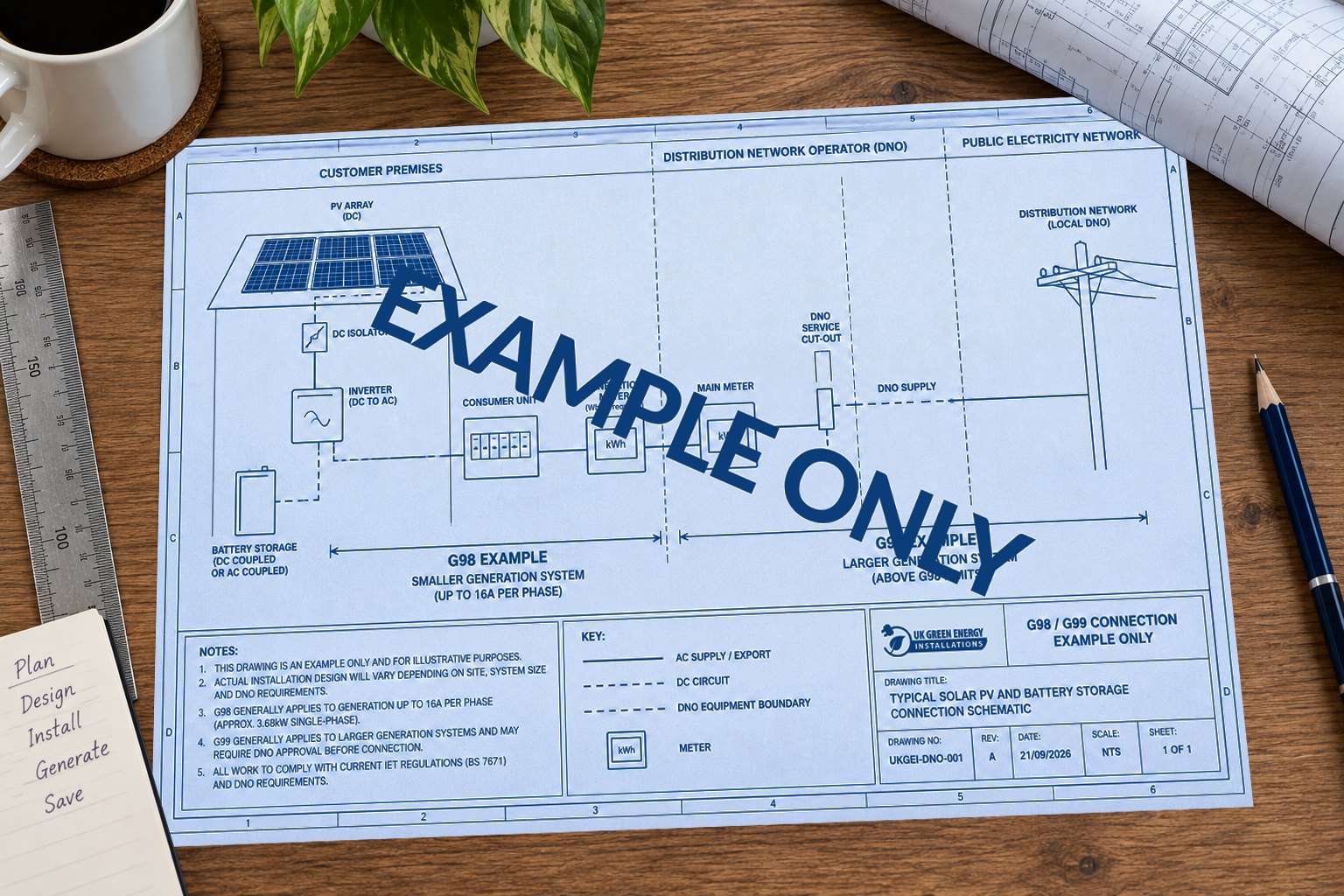
Do I Need DNO Approval for Solar Panels?
Potentially — although approval and notification aren't quite the same thing.
For some smaller installations, the system can be installed and the DNO notified afterwards, provided it meets the relevant requirements.
Larger systems and certain solar and battery configurations may require an application to be submitted and DNO approval obtained before connection.
The process generally falls under one of two engineering recommendations: G98 or G99.
At UK Green Energy Installations, we assess the proposed system and manage the appropriate DNO process as part of the installation.
What Is G98 for Solar Panels?
G98 is generally used for smaller generation systems with an output of no more than 16 amps per phase.
For a single-phase property, that's approximately 3.68 kW of AC generation capacity.
Provided the installation and equipment meet the relevant G98 requirements, this is generally a connect-and-notify process rather than requiring advance approval in the same way as a standard G99 application.
It's worth noting that this threshold relates to the electrical output of the generating equipment — not simply the combined wattage printed on your solar panels.
What Is G99 for Solar Panels?
If the proposed generation exceeds the G98 limits, G99 will generally apply.
Depending on the system, this can mean your installer needs to apply to the DNO before connecting the equipment.
The DNO assesses the proposed installation and its potential effect on the local electricity network. It may approve the design as proposed or place conditions on the connection.
The precise G99 process depends on the size and type of generation being connected.
| G98 | G99 | |
|---|---|---|
| Typical use | Smaller generation systems | Larger generation systems |
| General threshold | Up to 16 A per phase | Above G98 limits |
| DNO process | Usually connect, then notify | Usually requires an application and approval |
| Can apply to solar? | Yes | Yes |
| Can battery storage affect it? | Yes | Yes |
Does Battery Storage Need DNO Approval?
It can.
From the network's perspective, battery storage can act as both demand when charging and generation when exporting. The ENA therefore states that storage must meet the relevant G98 or G99 connection requirements according to the installation.
This becomes particularly important when combining solar PV with battery storage, because the overall system design and potential export need to be considered rather than looking at the solar panels in isolation.
If you're considering storage, see our Battery Storage options.
What If the DNO Won't Allow the Full Export?
A DNO connection decision doesn't necessarily mean you can't have the solar or battery system you want.
In some circumstances, an export limitation scheme can restrict the maximum amount of electricity exported to the network while allowing the property to have greater generation or storage capacity behind the meter.
The appropriate solution depends on the property, equipment and DNO requirements, which is why it's important to consider grid connection requirements during the design stage rather than after the equipment has been selected.
Who Applies for DNO Approval?
For a professionally installed solar and battery system, your installer will normally manage the relevant application or notification.
At UKGEI, this forms part of our system design and installation process. We'll determine the appropriate connection procedure, submit the required information and deal with the DNO where prior approval is necessary.
Our recent solar and battery storage installation in Wokingham is a good example. The system incorporated 5.88 kWp of integrated solar PV, 27.12 kWh of Sigenergy battery storage and a 10 kW Energy Controller, requiring DNO approval as part of the project.
What Does a DNO Application Include?
A DNO application can involve considerably more than simply completing a form. Depending on the system and type of application, your installer may need to provide technical information including:
Details of the solar PV and battery storage system
Inverter or energy controller make, model and maximum output
Single-line electrical diagrams showing how the equipment connects to the property and grid
Site or location plans
Manufacturer specifications and relevant equipment certification
Details of the property's existing electricity supply and connection
Proposed export capacity
Export limitation information where applicable
Commissioning information once the installation is complete
For a G99 application, this information allows the DNO to assess how the proposed generation and battery storage could interact with the local electricity network before approving the connection.
UKGEI prepares and submits the relevant technical information as part of the DNO process, so this isn't something the homeowner normally needs to produce themselves.
Planning Solar Panels or Battery Storage?
You don't need to work out whether your installation falls under G98 or G99 yourself. As part of the design process, UK Green Energy Installations will establish the appropriate DNO connection route and manage the necessary application or notification for your system.
Talk to us about your project →