
Churches, places of worship and community buildings can face a particular challenge when it comes to sustainability. Many occupy older buildings that were never designed with modern energy efficiency in mind, while also needing to balance running costs, comfort, heritage considerations and their responsibility to the communities they serve.
The good news is that becoming more sustainable doesn't necessarily mean making major changes to the church building itself.
From installing solar panels on a church hall or community building to reviewing electric heating, battery storage and EV charging, there are a number of ways churches can reduce their reliance on grid electricity and work towards a more sustainable future.
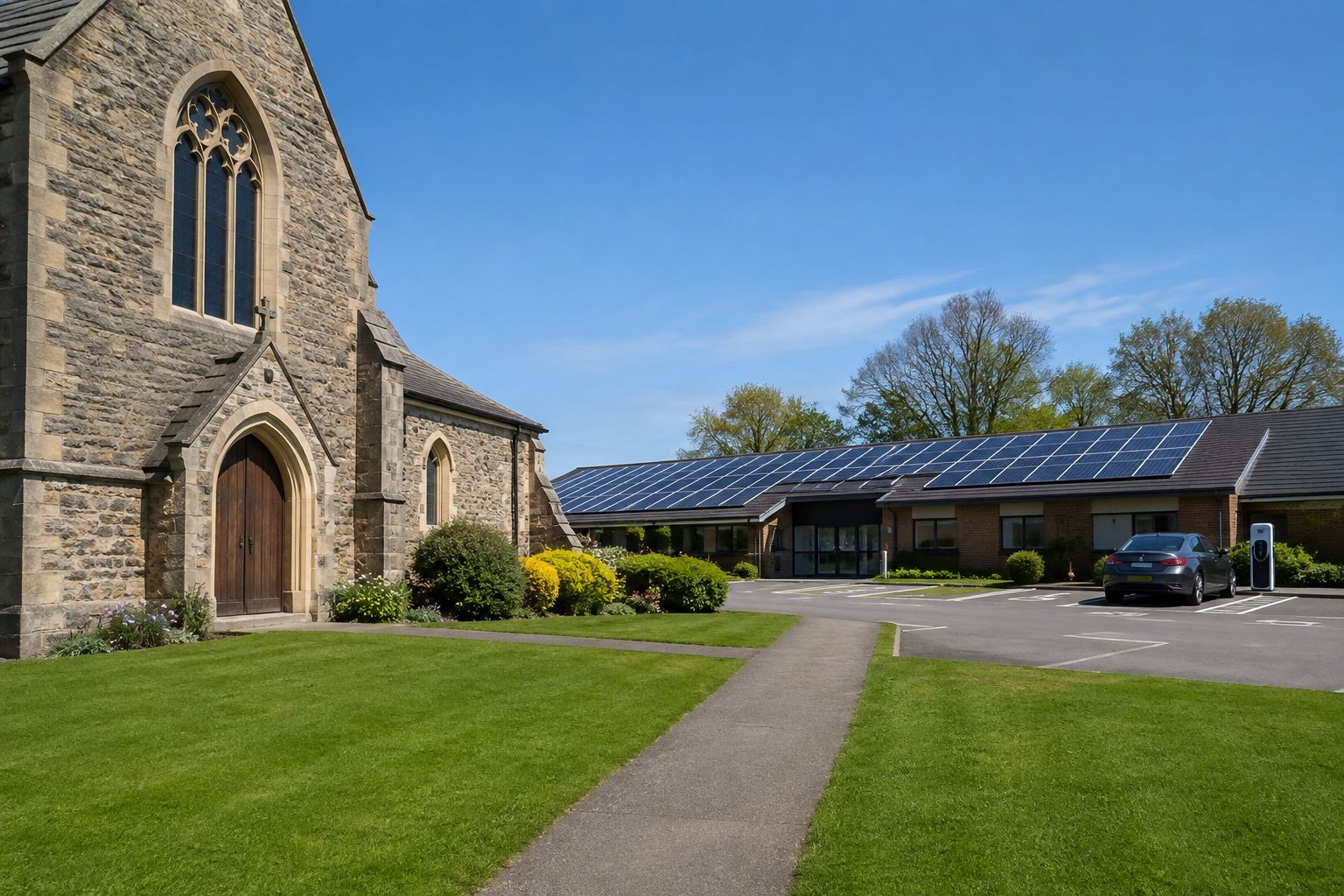
Start by Looking at the Whole Church Site
When people think about renewable energy for churches, solar panels on the main church roof may be the first thing that comes to mind.
However, this isn't always the most appropriate place to start.
Older churches may have historic roofs, architectural features, shading or planning and heritage considerations that make solar installation more complex. Instead, it can be useful to look at all the buildings and available space belonging to the church.
This could include:
Church halls
Community centres
Parish rooms
Offices
Modern extensions
Meeting rooms
Storage or ancillary buildings
Suitable car parking or external areas
A newer church hall with a large, relatively unobstructed roof, for example, could potentially provide a much simpler opportunity for generating renewable electricity than the main church building.
Solar Panels for Church Halls and Community Buildings
Church halls can be particularly well suited to solar PV because many have relatively large roof areas and are used throughout the week for community activities.
Solar panels generate electricity during daylight hours, which can then be used within the building rather than purchasing all of that electricity from the grid.
Depending on how the site is metered and configured, solar generation may potentially contribute towards electricity being consumed elsewhere on the church site too. This needs to be assessed individually because every electrical installation and site layout is different.
For churches looking to reduce both their environmental impact and long-term electricity costs, a commercial solar installation can therefore be worth investigating.
Could Battery Storage Help a Church?
Solar generation and electricity consumption don't always happen at the same time.
A church hall might generate significant solar electricity during a bright weekday but have greater electricity demand during an evening meeting, service or community event.
Battery storage can provide another option by storing electricity for use later, subject to the way the system is designed and the church's individual energy profile.
Battery storage can also potentially be used with certain electricity tariffs to charge at cheaper times and use stored electricity when grid prices are higher.
Rather than automatically adding a battery, however, we recommend assessing the church's electricity consumption first. The right solution should be based on how and when the site actually uses energy.
Making Church Heating More Sustainable
Heating is often one of the biggest challenges for churches.
Traditional church buildings can have large internal spaces, high ceilings and limited insulation, making them very different from heating a modern home or office.
Rather than simply replacing one heating system with another, churches should consider how individual areas are actually used.
For example, does the entire building need heating for a small weekday meeting, or would a more targeted approach be appropriate?
Modern electric heating solutions can potentially form part of a wider sustainability strategy, particularly where electricity can be supported by on-site renewable generation.
This might include reviewing heating within:
Church halls
Meeting rooms
Offices
Community spaces
Frequently occupied areas
Extensions and newer parts of the building
Every church is different, so heating should be assessed around the building, occupancy patterns and existing electrical infrastructure rather than treated as a one-size-fits-all solution.
Solar Power and Electric Heating
Electrifying heating can increase electricity consumption, which makes it particularly important to consider it as part of a wider energy strategy.
Where appropriate, combining solar PV, battery storage and efficient electric heating could allow a church or community building to generate some of the electricity required on site.
The objective isn't necessarily to become completely independent from the electricity grid. Instead, it is about identifying practical opportunities to reduce energy consumption, generate renewable electricity and use that electricity more effectively.
EV Charging for Churches and Community Facilities
Churches with their own car parks may also want to consider EV charging points as part of their longer-term sustainability plans.
Chargers could potentially support staff, clergy, volunteers, visitors or community users, depending on how the site operates.
Where solar PV is installed, EV charging can also form part of a wider renewable energy strategy rather than being considered as a completely separate project.
Start With Energy Usage, Not Equipment
It can be tempting to begin with a particular technology: We need solar panels, we need a battery or we need new heaters.
A better starting point is often:
How does our church currently use energy, and where could we improve it?
Electricity bills, half-hourly consumption data where available, building usage, heating requirements, roof space and the existing electrical installation can all help establish which improvements are likely to provide the greatest benefit.
For some churches, solar PV may be the priority. For others, improving heating controls or changing the way individual rooms are heated could come first.
For larger sites, a combination of technologies may provide the most effective long-term solution.
Don't Forget the Existing Electrical Infrastructure
Before introducing additional electrical loads or renewable technologies, the existing installation needs to be considered.
Older church and community buildings may have electrical systems that have developed over many decades.
Depending on the proposed project, it may be necessary to assess elements such as:
Incoming electrical supply
Distribution boards
Available electrical capacity
Existing circuits
Three-phase supplies
Earthing and bonding
Condition of the existing electrical installation
This is particularly important when considering higher-demand equipment such as electric heating and EV chargers.
A Phased Approach to Church Sustainability
Becoming more sustainable doesn't necessarily have to happen through one large project.
A church could develop a longer-term plan, for example:
Stage 1 – Understand current energy consumption
Review bills, electricity usage, heating and how different buildings are occupied.
Stage 2 – Identify energy-saving opportunities
Look at lighting, heating controls and unnecessary consumption.
Stage 3 – Generate renewable electricity
Assess suitable roofs on the church, hall or other buildings for solar PV.
Stage 4 – Make better use of generated energy
Consider battery storage where the church's consumption profile supports it.
Stage 5 – Electrify other areas
Explore appropriate heating upgrades and EV charging as part of the wider energy strategy.
This allows improvements to be prioritised according to available budgets, practical requirements and potential energy savings.
Renewable Energy Solutions for Churches in Surrey, Hampshire and Berkshire
UK Green Energy Installations works with organisations across Surrey, Hampshire and Berkshire to design renewable energy systems around individual buildings and their energy requirements.
For churches, places of worship and community organisations, that means looking beyond an individual product and considering the wider site.
Whether you are considering solar panels for a church hall, battery storage, EV charging or a wider renewable energy project, we can assess the available options and help determine which solutions are appropriate for your buildings.
Considering How to Make Your Church More Sustainable?
If your church, parish or community organisation is starting to explore renewable energy, you don't need to know exactly which technology you need before speaking to us.
Tell us about your buildings, current energy use and what you would like to achieve, and we can help you explore the practical options.
Talk to UKGEI about renewable energy for your church or community buildings.
Frequently Asked Questions
Can churches install solar panels?
Yes. Churches and other places of worship can install solar panels where the building and roof are suitable. However, the main church building isn't always the best location, particularly where there are heritage, planning, shading or roof constraints. Church halls, community centres, offices and other church-owned buildings may provide suitable alternative roof space for solar PV.
Are there grants available for churches wanting to install solar panels?
Funding may be available for eligible community-led renewable energy projects. Faith organisations are among the types of organisations that may be eligible for schemes such as the Great British Energy Community Fund, subject to the individual funding criteria and availability. UKGEI has a separate guide explaining the Great British Energy Community Fund 2026 and the types of community renewable energy projects it can support.
How does the solar installation process work for a church or community building?
Every project starts by understanding the building, its electricity consumption and what the organisation wants to achieve. The site and electrical infrastructure can then be assessed before an appropriate solar PV system is designed. Larger or more complex installations may also require additional grid connection considerations. Our guide to how the solar installation process works explains the main stages from initial enquiry and survey through to design, installation and commissioning.
Can a church combine solar panels with battery storage and EV charging?
Yes. Solar PV can form part of a wider energy strategy that also includes battery storage and EV charging. A battery can potentially store surplus solar electricity for use later, while churches with suitable car parks may consider EV charging for staff, volunteers, visitors or community users. The most appropriate combination will depend on the site's electricity consumption, available capacity and how the buildings are used.
Can solar panels and renewable energy be installed at vicarages, cathedrals, abbeys and other religious buildings?
Yes. Renewable energy solutions can potentially be installed across a wide range of religious and church-owned properties, including vicarages, cathedrals, abbeys, chapels, parish halls, church halls, community centres and other places of worship. Solar panels may be suitable for the main building or, where heritage, planning, roof condition or visual considerations make this more complicated, an adjoining hall, office, vicarage or other church-owned building could provide an alternative location. Battery storage, EV charging and more sustainable electric heating may also form part of a wider energy strategy. Listed buildings, conservation areas and historic religious buildings can require additional consideration, so every site should be assessed individually.