
From 27 August 2026, plug-in solar panels can legally be bought and used by households across Great Britain, introducing a new and much more accessible way for people to generate some of their own electricity at home.
The government says compliant plug-in solar kits can provide up to 800W of power and could save some households up to £110 a year on their electricity bills.
So, are plug-in solar panels an alternative to having solar panels professionally installed on your roof?
Not quite.
While both technologies use solar panels to generate electricity, the size, capability and intended use of the two systems are very different.
What Are Plug-in Solar Panels?
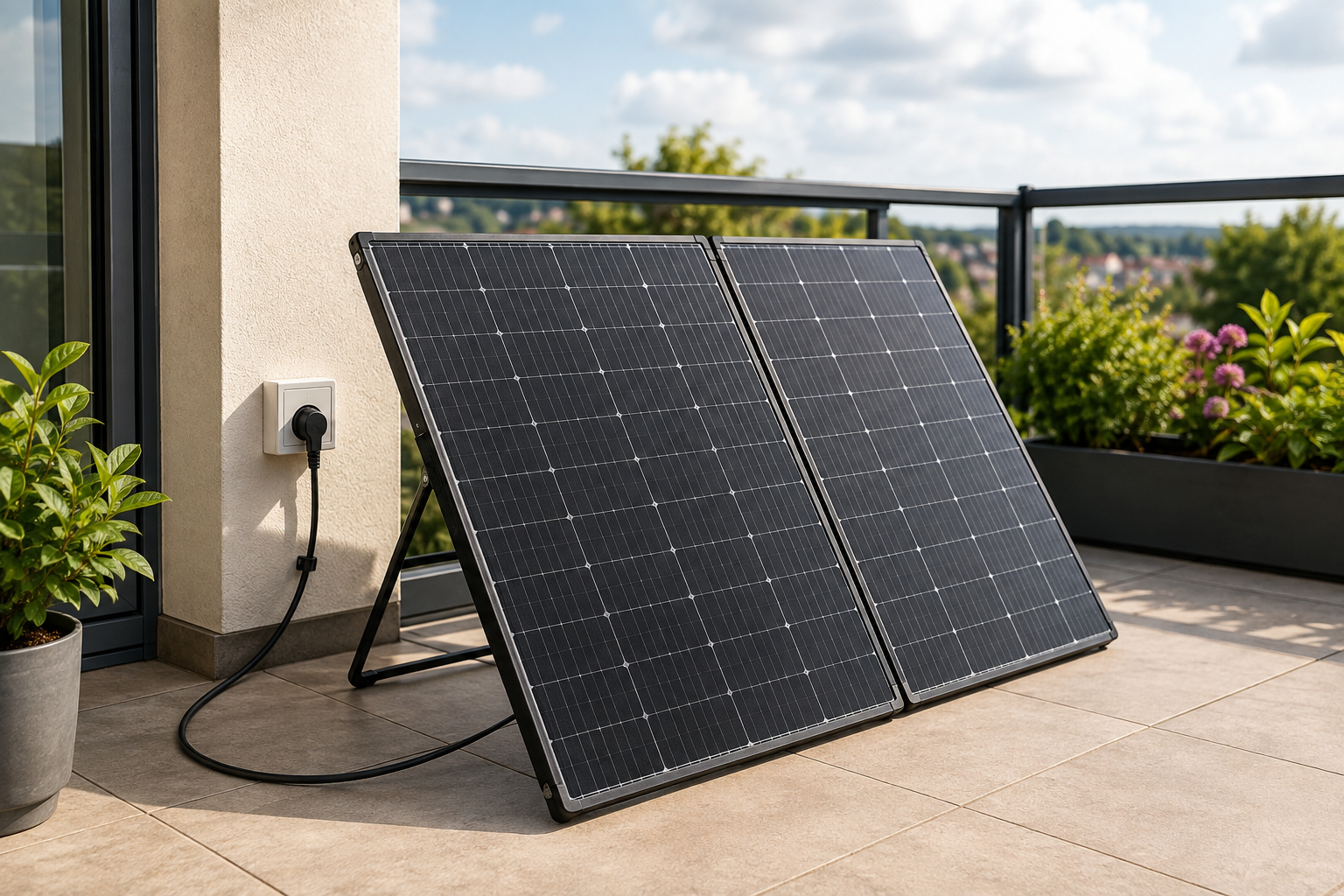
A plug-in solar system typically consists of one or more solar panels, a microinverter, mounting equipment and a manufacturer-supplied cable and plug.
Rather than being permanently wired into the property's electrical installation in the same way as a conventional solar PV system, an approved plug-in system connects to a suitable household socket.
The electricity generated can then contribute towards the electricity being used within the home, reducing the amount that needs to be purchased from the grid.
Under the new UK specification, plug-in solar is limited to a maximum inverter output of 800VA, with the current specification allowing one plug-in solar product per household.
Plug-in Solar vs Professionally Installed Solar Panels
Although both produce renewable electricity, they shouldn't really be viewed as equivalent solar systems.
| Plug-in Solar Panels | Professionally Installed Solar Panels | |
|---|---|---|
| Main purpose | Offset a smaller amount of household electricity use | Generate a significant proportion of household electricity |
| System size | Up to 800VA inverter output under the current UK framework | Typically several kW, sized for the property and energy use |
| Number of panels | Usually a small number of panels | Can make use of substantially more available roof space |
| Installation | Designed for suitable consumer installation using a compliant product | Professionally designed, installed and commissioned |
| Typical location | Balconies, terraces or other suitable outdoor locations | Usually roof-mounted, with other configurations possible |
| System design | Relatively standardised small system | Designed around roof space, orientation, shading and household energy use |
| Battery storage | Plug-in battery storage is not covered by the current plug-in solar specification | Can be designed with integrated home battery storage |
| Using solar later | Most useful when electricity is being consumed while the panels are generating | Surplus solar can be stored in a battery for use later in the day |
| Generation potential | Limited by the smaller system size | Considerably greater potential with a suitably sized rooftop system |
| Export payments | Should not automatically be assumed | Eligible systems may be able to access Smart Export Guarantee tariffs |
| Upfront cost | Lower initial cost | Higher investment reflecting system size, design and professional installation |
| Best suited to | Renters, flats, balconies or households unable to install rooftop solar | Homeowners wanting greater generation, battery storage and long-term energy savings |
| Grid connection / DNO | Small plug-in systems operate within the specific limits set for compliant plug-in solar products. | Larger professionally installed systems may require prior approval from the local Distribution Network Operator (DNO), depending on the system capacity and connection arrangement. |
Putting the Difference in Scale into Context
One way to understand the difference between plug-in solar and a professionally installed rooftop system is to look at how larger solar installations interact with the electricity network.
Plug-in solar is deliberately limited to a relatively small output. By comparison, a professionally designed rooftop solar system may generate several kilowatts of power and, depending on its capacity and connection arrangement, may require approval from the local Distribution Network Operator (DNO) with either a G98 or G99 application, before it can be connected.
This is because a larger solar installation doesn't simply reduce the electricity a property takes from the grid. At times it can generate more electricity than the property is using and export that surplus back onto the local electricity network.
For some installations, the installer can notify the DNO after commissioning under the appropriate connection procedure. Larger systems or certain connection arrangements can require an application and approval before installation.
It helps put the difference into perspective: plug-in solar is intended to provide a relatively small contribution towards a household's electricity use, whereas a professionally designed solar installation can become a significant part of the property's overall energy system.
What Does the Difference in Capacity Mean in Real Life?
Plug-in solar systems are limited to 800VA, while a professionally installed 12–14 panel system can be several kilowatts in size. The example below shows how that difference in capacity can affect the amount of energy available for everyday household use and EV charging.
Plug-in Solar
Up to 800VA
Under strong solar conditions, a compliant plug-in system could theoretically generate up to around 0.8kWh in one hour while operating at maximum output.
Illustrative examples:
Washing machine:
If a wash cycle uses around 0.5kWh, an 800W system could theoretically generate that amount of energy in under one hour at full output.
EV charging:
To generate 7kWh of energy for an electric vehicle, an 800W plug-in system would theoretically need around 8.75 hours operating continuously at maximum output.
Best suited to:
Offsetting smaller household loads such as lighting, Wi-Fi, TVs, laptops and other background electricity use.
Professionally Installed Solar
12–14 panels: approx. 5.4–6.3kWp*
A larger rooftop solar system can generate several kilowatts at once, allowing it to contribute far more significantly to household electricity demand.
Illustrative examples:
Washing machine:
A 5.4–6.3kWp system operating at full output could theoretically generate 0.5kWh in just a few minutes.
EV charging:
To generate 7kWh of energy, a 6.3kWp system would theoretically need just over 1 hour at full output, while a 5.4kWp system would need around 1 hour 18 minutes.
Best suited to:
Supporting larger household loads, battery storage and EV charging while reducing reliance on grid electricity.
So, Are Plug-in Solar Panels a Good Idea?
For the right household, we think they could be.
Plug-in solar potentially gives people who have previously been excluded from solar generation an opportunity to produce some renewable electricity themselves.
Someone renting a property, living in a flat with a suitable balcony or unable to justify the investment in a complete rooftop solar installation may now have another option.
It could also introduce many more people to the idea of generating and consuming their own electricity.
However, it's important to have realistic expectations.
An 800W plug-in system is very different from a professionally designed rooftop solar array capable of producing several kilowatts.
If your objective is simply to reduce a little of your daytime grid consumption, plug-in solar could be worth considering.
If your objective is to make a much more substantial reduction in the amount of electricity you purchase from the grid, the conversation is likely to be very different.
What About Battery Storage?
This is perhaps one of the biggest differences.
A professionally installed solar PV system can be designed alongside battery storage.
During sunny periods, solar electricity that isn't immediately required by the home can charge the battery. That stored energy can then be used later in the afternoon, evening or overnight when the solar panels aren't producing enough electricity.
Some modern battery systems can also charge using cheaper off-peak electricity from the grid and make that energy available when electricity prices are higher.
The government's current plug-in solar specification specifically does not cover plug-in battery systems or plug-in solar products integrated with batteries.
So if battery storage is an important part of what you want to achieve, a professionally designed solar and battery installation remains a very different solution.
Does Plug-in Mean Every Home Is Suitable?
No.
This is an important distinction.
Consumers should only purchase products that comply with the new UK requirements and should follow the manufacturer's instructions carefully.
Electrical Safety First has also advised that homeowners shouldn't automatically assume their existing electrical installation is suitable simply because a product has a plug. In particular, it recommends appropriate RCD protection and advises people with older properties, unknown electrical installations or older protective devices to consider having their electrics assessed by a competent electrician before using plug-in solar.
Extension leads and adapters should not be used to connect a plug-in solar system.
Property considerations can apply too. Depending on the property, permission may be required from a landlord, building owner or freeholder, and planning or listed-building restrictions may also need to be considered.
Our View at UK Green Energy Installations
“The introduction of plug-in solar is a positive step because it gives more households an opportunity to generate some of their own electricity, particularly renters and people who may not be able to install a conventional rooftop solar system.
However, consumers should understand that plug-in solar and a professionally installed rooftop solar and battery system serve quite different purposes.
Plug-in systems are relatively small and are primarily designed to offset electricity being used in the home while the panels are generating. A professionally designed rooftop system can use considerably more available roof space, generate much more electricity and be designed around the household's actual energy consumption.
It can also integrate solar generation with battery storage, allowing households to store surplus solar energy for use later in the day.
For people who rent, live in flats or simply want a small and relatively inexpensive introduction to solar generation, plug-in solar could be a useful option. For homeowners looking to make a significant long-term reduction in their reliance on grid electricity, professionally designed solar and battery storage remains a very different proposition.”
UK Green Energy Installations
Which Type of Solar Is Right for You?
The answer ultimately depends on what you want solar to achieve.
If you're looking for a relatively inexpensive way of generating a small amount of electricity and don't have access to a suitable roof, plug-in solar could open up an interesting new option.
If you own your home and want to maximise the amount of electricity you can generate, potentially store surplus energy in a battery and significantly reduce your reliance on grid electricity, it's worth looking at a professionally designed system.
At UK Green Energy Installations, we design and install solar panel and battery storage systems for homes across Surrey, Hampshire and Berkshire.
If you're considering solar, you can also read our How Solar Works guide to understand the complete process, from the initial design and installation through to generating, storing and exporting your own electricity.
Frequently Asked Questions
Will plug-in solar panels generate enough electricity to charge my electric car?
A plug-in solar system can contribute towards the electricity being used while your EV is charging, but its output is relatively small compared with the power required by a typical home EV charger.
Under the current UK framework, plug-in solar is limited to 800VA, whereas a typical home EV charger can operate at around 7kW. This means plug-in solar alone would not normally provide enough power to run a 7kW EV charger, with the remaining electricity being drawn from the grid.
A larger professionally installed solar PV system can generate several kilowatts and can be designed alongside battery storage and an EV charger, making it much better suited to households wanting to use their own renewable electricity to help charge an electric vehicle.Are plug-in solar panels now legal in the UK?
From 27 August 2026, compliant plug-in solar products can legally be bought and used across Great Britain under the new regulatory framework. Products must meet the relevant UK requirements.
How powerful can plug-in solar panels be?
The current UK interim product specification limits plug-in solar systems to a maximum apparent power of 800VA.
How much can I save with plug-in solar?
The UK government says households could save up to £110 per year, although actual savings will depend on factors including panel position, shading, electricity consumption and how much generated electricity is used while the panels are producing power.
Can I connect a battery to plug-in solar panels?
The current UK plug-in solar specification does not cover plug-in battery systems or plug-in solar devices integrated with batteries. Homeowners wanting solar integrated with battery storage should consider an appropriately designed and installed solar and battery system.
Is professionally installed solar better than plug-in solar?
They are designed for different requirements. Plug-in solar provides a lower-cost way of generating a relatively small amount of electricity. A professionally installed solar system can provide considerably greater generation capacity and can be designed around the property, household electricity consumption and battery storage requirements.